01 / EVIDENCE INTELLIGENCE · MATERIALS FOR THE LEGAL TEAM
A material becomes useful for a dispute once its source, content and connection to the event are established
BLACKFILE helps a legal or corporate team separate found material from a verified fact. For each material element, the source, date of access, context, connection to the matter and limitation are recorded.
We work only with lawfully accessible materials and do not promise procedural admissibility - that is determined by the court and the client's legal team.
dispute, verification of a claim or preparation of a position
Number of episodes
from a single circumstance to a series of events
Jurisdictions
agreed before work begins
Estimated timeframe
stated after the task is described
At the first stage, a description of the circumstance and the stage of the dispute is sufficient. Documents are provided only after a secure channel has been agreed.
SOURCE RECORD
Source
Открытый реестр
Дата доступа
05.08.2026
Status
Confirmed in part
02 / SITUATIONS
When there is a large volume of information but its evidentiary value remains unclear
01
Corporate dispute
Establish documents, registration actions, statements, publications and connections between events.
02
Breach of obligations
Compare the contractual sequence with payments, actions of the parties and external circumstances.
03
Asset diversion
Record corporate changes, transfer of control, movement of assets and related structures.
04
Reputational conflict
Establish the original source of statements, the sequence of distribution and the factual basis of publications.
05
International dispute
Collect and bring into a single structure materials from different countries, languages and sources.
06
Internal incident
Verify documents, communication events, access levels and the sequence of actions.
03 / MATERIALS
What materials we work with
The composition is determined by the task and jurisdiction. Work is carried out only with lawfully accessible information and materials transmitted through a secure channel.
M-01corporate and registration information
M-02court and administrative materials
M-03public statements
M-04publications and archived versions of pages
M-05digital traces
M-06metadata of lawfully provided files
M-07photographs and video materials
M-08connection maps
M-09financial and asset-related indicators
M-10open-source information on movements and events
M-11documents provided by the client through a secure channel
Whether the authenticity of a specific document can be confirmed depends on its nature, source and the verification methods available. Where authenticity cannot be established, this is stated explicitly.
04 / EVIDENCE CHAIN
Each material passes through the same chain - from discovery to delivery
The chain shows how an element turns from a finding into working material for the legal team. All interface data are fictitious.
EV-014
Change of director at the counterparty company
Confirmed source
Discovered
Recorded
Verified
Compared
Delivered
Date of discovery
D2
Presumed date of creation
One month before the dispute
Source
Official corporate register
Method of capture
Extract with date and record details
Technical identifier
sha256 · a41f…09d2
Related event
Change of signatory prior to the transaction
Limitations
Reason for the change is not established from the register
Transfer status
Included in the package for the legal team
Red marks are used only for a contradiction, a broken sequence or a critical gap. Material of unestablished origin is never presented as confirmed.
Materials of different origin are brought together on a single work surface: for each, the source, date of access and what it does not confirm are recorded.
05 / VERIFICATION SYSTEM
A single file found does not by itself confirm a fact
01
Source
Where the material was found or from whom it was obtained.
02
Date
When it was created, published, modified or recorded.
03
Integrity
Whether there are signs of alteration.
04
Context
What occurred before and after.
05
Independent confirmation
Whether the content matches other sources.
06
Relevance to the matter
What fact the material can confirm.
07
Limitations
What cannot be established from the material.
FOUND / PROVEN
Finding the material is half the work. The other half is proving where it came from and what it relates to.
06 / RESULT
A set the legal team works with without decoding
R-01material index
R-02register of sources
R-03chronological table
R-04Evidence Chain for material elements
R-05map of facts and supporting materials
R-06list of contradictions
R-07list of missing information
R-08appendices with source links and technical data
R-09Executive Brief
R-10secure transfer of the agreed set
R-11closed briefing for the legal team
07 / HOW THIS LOOKS IN PRACTICE
Composite example
Corporate changes ahead of a dispute
A composite example based on typical matters. Details have been changed, and the outcome of the dispute is not described.
01
What the other side claimed
The other party described the change of management and transfer of shares as sequential, planned actions unrelated to the subject of the dispute.
02
What materials were available
The client provided correspondence and copies of corporate resolutions; open registration records and publications from the same period were also available.
03
What independent sources confirmed
Registration actions and their dates were confirmed by registry records. Some decisions were confirmed only by client copies - this is recorded under a separate status.
04
Where the discrepancy arose
The dates of two corporate actions in the client's copies and in the registry did not match. The discrepancy is recorded as a discrepancy, not as an indication of forgery.
05
How the material was organized
Each item received a source, access date, context, connection to the matter in dispute, and a limitation. The chronology was compiled by the dates of confirmed records.
06
What was delivered to the legal team
A material register, source log, chronology, confirmation matrix, and a list of questions that only counsel can resolve.
07
What questions remain open
Procedural admissibility of the materials, the significance of the date discrepancy, and the need for an official request remain with the client's legal team.
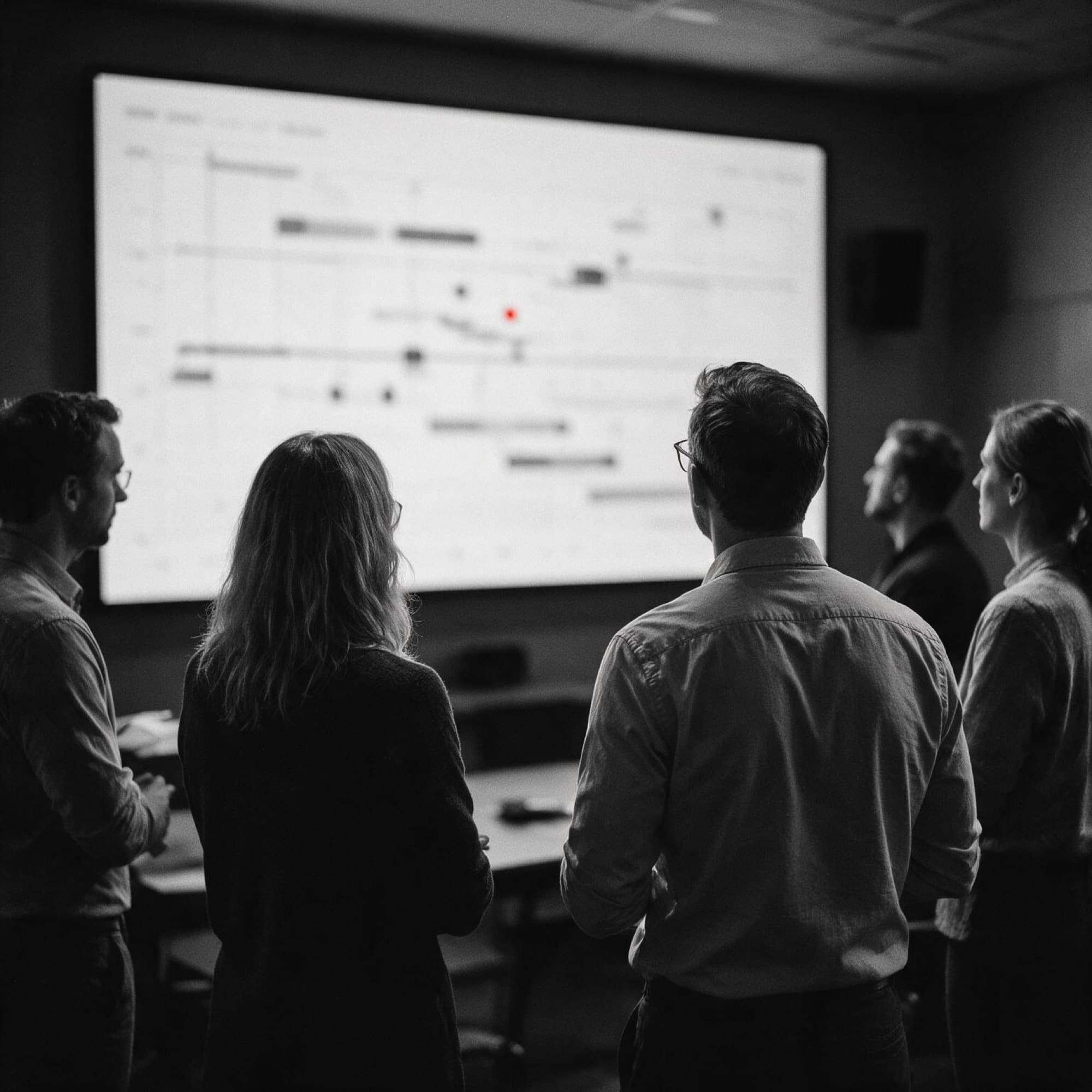
Illustrative image. The persons shown are not parties to an actual dispute, and the materials on screen are illustrative.
08 / PROCESS
From legal assessment of the task to secure delivery
01Legal and ethical assessment of the task
02Definition of the factual questions
03Mapping of possible sources
04Search for and recording of materials
05Verification and cross-checking
06Organization and indexing
07Quality control
08Secure delivery and briefing
09 / ENGAGEMENT FORMATS AND FEES
Format depends on the number of episodes, jurisdictions and volume of sources
01
Evidence Assessment
from €4,500
Timeframe: 5-8 business days
Initial assessment of available materials and a map of sources for one episode.
Includes
one episode
one main jurisdiction
up to five factual questions
verification of available sources
preliminary index
gap map
02Most requested
Evidence Intelligence
12 000-30 000 €
Timeframe: 15-30 business days
Full cycle: search, recording, verification, and a structured package for the legal team.
Includes
several episodes
extended search
verification of sources
timeline
Evidence Chain
map of contradictions
structured package
closed briefing
03International projects
Complex Evidence Project
After assessment
Timeframe determined after assessment of the task
Project-based work for large disputes with staged delivery of materials.
Possible composition
several countries
large number of participants
multilingual sources
staged delivery
dedicated project team
regular updates
coordination with several legal counsel
The final cost depends on the number of episodes, participants, jurisdictions, languages, and the required depth of verification. Scope and stages are agreed before work begins.
10 / LEGAL LIMITS
Material has value only if obtained lawfully
BLACKFILE finds, records, verifies and structures information. Admissibility, relevance and the manner of procedural use are determined by the legal team and the competent court.
BLACKFILE не осуществляет
hacking of devices and accounts
unlawful acquisition of correspondence
falsification of materials
pressure on witnesses
provocation of unlawful acts
covert intrusion
unlawful recording
alteration of source files
presenting analytical material as court-recognized evidence
Lawfully accessible: corporate and court information, publications and their archived versions, digital traces, photographs and video materials, and documents the client provides through a secure channel. Materials requiring unlawful access - correspondence of third parties, content of other people's devices, closed databases - are not examined under any circumstances.
Often - yes, based on the metadata of a lawfully provided file, comparison with independent sources, archived versions and context. But not always: if provenance cannot be established, the item is marked "provenance not established" and is delivered only with that qualification, not presented as confirmed.
Yes. Archived copies help establish the first available version of a publication, the date of changes, and discrepancies between versions. We record both the current and the archived version with access dates, so the provenance of each copy can be traced.
The file is prepared for ease of use by a legal team: sources, dates, method of capture and limitations are indicated for each item. Admissibility and the manner of procedural use are determined by counsel and the competent court - we do not promise that the material will be accepted as evidence.
Source files are not altered. Checksums and the method of acquisition are recorded for material items, with a chain of custody maintained where required. Any analytical work is performed on copies, and discrepancies between versions are noted separately.
Yes, this is a standard engagement format: the legal team formulates the factual questions, and we gather and verify materials to address them. The file and briefing are structured around the case as defined by the legal team.
Yes. Materials from different jurisdictions and languages are brought into a single structure: a common index, a unified timeline and an end-to-end source register indicating country and original language. Source availability differs from country to country, and this is reflected in the gap map.
Archived versions, copies, reprints and indirect confirmations of the material's existence are checked. If the content cannot be recovered, the fact of deletion itself is recorded along with the date of discovery - at times this is no less significant than the original material.
13 / INITIAL ASSESSMENT
Describe the circumstance that needs to be confirmed
Do not send documents or personal data before a secure channel has been agreed. At the first stage, a description of the task is sufficient.
A dispute is not won by the party with more files, but by the party whose materials withstand scrutiny
Describe the circumstance, the stage of the dispute and the nearest deadline. BLACKFILE will assess the range of possible sources and propose a format of work