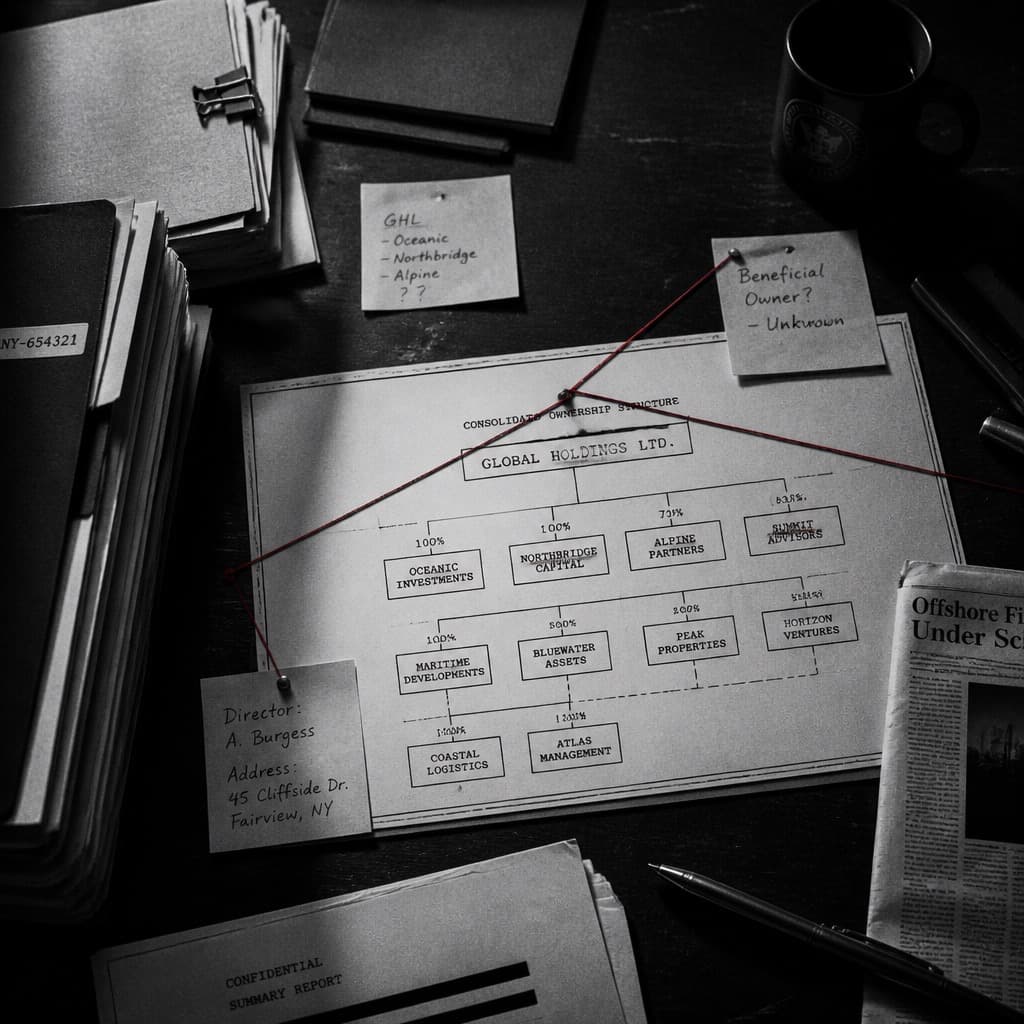
Registration confirms that a company exists, but does not explain who controls it or how it operates
BLACKFILE examines a company as an operating system: registration, owners, ultimate beneficial owners, management, connections, business history, litigation history and indicators of actual operations.
Every material conclusion is given a source, a date and a level of confirmation. A closed link or an indirect connection is marked as a limitation, not replaced by a confident assumption.
An extract answers the question "does the company exist", not "what is it"
A company may have been registered long ago, keep neat accounts and have a presentable website - and still be owned by people other than those stated, conduct a different activity, or belong to a group of structures that the counterparty is not told about.
Checking a company means reconstructing the picture: who owns it, who controls it, what the structure actually does, who it is connected to, and what events preceded the transaction or partnership.
We verify not the registration document, but the company as an operating structure with a history, owners and connections.
03 / PAPER / REALITY
An extract answers the question of how a company is registered. A check answers how it operates
REGISTRY
Formal structure
registration
address
director
shareholder
stated line of business
VS
REALITY
Actual picture
actual operations
operational infrastructure
controlling persons
related companies
actual partners
sources of funding
litigation and reputational context
What matters is not the discrepancy between the columns itself, but its cause and its effect on your decision.
ГЛАВА 02Кто владеет и контролирует
04 / OWNERSHIP & CONTROL MAP
The ownership chain is disclosed level by level - down to the ultimate individuals
The map shows how the structure check is built: each node is given a status, a jurisdiction and a comparison of what is claimed against what can be confirmed. Control without formal ownership is checked separately.
N-04
Ultimate beneficial owner
Presumed beneficial owner~Analytical assessment
Share100% declared
PeriodBased on the totality of records
SourceRegistries and documents
Level of confirmationPresumably
Jurisdiction
Established by the totality of evidence
What is claimed
One individual has been declared as the beneficial owner.
What can be confirmed
The totality of indicators points to the same person, but one link in the chain is not documented.
What this means for the check
The status remains presumed until each link is confirmed by a document or registry.
Legal ownership
Economic interest
Management control
Historical connection
Only material discrepancies are marked in red. The status "structure not disclosed" is a recorded limit of the check, not a conclusion of wrongdoing.
05 / BENEFICIAL OWNERSHIP
The ultimate beneficial owner is always a natural person, but the path to that person may run through several structures
ГЛАВА 03Как компания действует
06 / CORPORATE TIMELINE
A history of changes explains a company better than its current snapshot
The timeline is reconstructed from registry records and disclosures: what changed, in what order, and what occurred around those dates.
Transfer of assets, change of participants or directors on the eve of a transaction - the most significant signal in the timeline.
Only a change materially affecting risk is marked in red.
07 / ACTUAL ACTIVITY
The company must exist not only in the register but also in economic reality
We compare declared capacity and scale against observable indicators: people, premises, licenses, and traces of actual operations.
A-01personnel
A-02infrastructure
A-03licenses
A-04counterparties
A-05products
A-06public activity
A-07address
A-08actual operations
ГЛАВА 04Что получает клиент
08 / WHAT IS CHECKED
Twelve sections of corporate due diligence
Composition is aligned with the purpose. Areas closed in a specific jurisdiction are recorded as limitations, not silently omitted.
Legal Status
Registration status, legal form, date of formation and current state of the company.
Sources
Corporate registries
Official publications
Result
Confirmed status and the history of its changes.
Limitations
The extent of disclosure depends on the jurisdiction.
09 / CORPORATE DUE DILIGENCE FILE
What the structure of a corporate file looks like
CORPORATE DUE DILIGENCE FILESAMPLE01
Company Profile
Key information and registration history
Demonstration format. Not a description of any specific company.
A company on paper and a company in fact are not always the same organisation.
PAPER / REALITY
10 / RESULT
An ownership chart and a picture of risk, not a stack of extracts
DELIVERABLES / STRUCTURECOMPANY DUE DILIGENCE
R-01corporate profile
R-02ownership structure
R-03identified beneficial owners
R-04management and control map
R-05related persons and companies
R-06corporate chronology
R-07financial indicators
R-08litigation and regulatory matters
R-09sanctions result
R-10reputational profile
R-11list of discrepancies
R-12risk map
R-13register of sources
ГЛАВА 05Как начать
11 / COMPOSITE EXAMPLE
Composite example
When the structure turns out to be different from what was stated
=Company under reviewConfirmed
!Financing and security rightsDocument required
!Contractual powersDocument required
CDD-01Composite example
The formal structure was confirmed but did not explain the economic dependency
Before the transaction, the buyer received a corporate chart in which owners and shares were consistently stated. The check confirmed the registry records but showed that financing and key contractual rights were tied to another company.
BLACKFILE separated legal ownership, economic dependency and unconfirmed assumptions. The client received a structure map, a list of documents to request, and questions that needed to be closed under the terms of the deal.
CDD-02
A related company ahead of a partnership
Задача. The prospective partner presented itself as an independent company; verification of its environment was required.
Что установлено. Shared addresses, managers and members pointed to a group of structures under common control, including a company involved in a dispute with a former partner.
Влияние на решение. The partnership was restructured: disclosure of the group was fixed in the agreement as a separate representation.
CDD-03
Actual activity of the counterparty prior to payment
Задача. The supplier claimed production capacity and years of experience; the client was preparing an advance payment.
Что установлено. The declared facility was not confirmed; operations were conducted through a different structure with a different history.
Влияние на решение. The client changed the payment scheme and requested security before transferring funds.
12 / ENGAGEMENT FORMATS AND FEES
Depth depends on the structure, the number of jurisdictions and the purpose of the check
A simple company with transparent ownership and an international group with concealed control represent different scopes of work. Timelines are counted from the agreement of scope.
Сравнение трех форматов проверки
Параметр
01Company Check
02Corporate Due Diligence
03Complex Ownership Investigation
Companies in scope
One
One and connected companies
Several
Jurisdictions
One primary
Several
International group
Depth of ownership
First-line owners
Down to ultimate beneficial owners
Chains and control without ownership
Result format
Corporate profile
Corporate Dossier
Investigation plan and dossier
Working session
Not included
On request
Included
01
Company Check
from €3,500
Usually 5-8 business days
Suitable for checking a counterparty before a contract or delivery.
Included
one company, one primary country
first-line owners and management
registration history
litigation indicators
sanctions indicators
02Recommended format
Corporate Due Diligence
from €7,500 to €18,000
Usually 10-20 business days
Suitable where the decision is material and a full picture of the structure and beneficial owners is required.
Included
multiple levels of ownership and beneficial owners
related companies and management
financial indicators and liabilities
litigation and reputational matters
corporate chronology and ownership structure
03Concealed structures
Complex Ownership Investigation
On request
Timeframe determined after briefing
Suitable for complex ownership chains, multiple countries and de facto control without formal ownership.
Suitable for
multiple countries
funds and trusts
nominee structures
complex ownership chains
de facto control without ownership
The final fee depends on the number of companies, ownership levels, jurisdictions, depth of verification and availability of sources. Third-party costs are agreed before work begins.
13 / ADMISSIBILITY
The structure is disclosed by lawful means
BLACKFILE works with registries, corporate disclosures, court records, financial statements and other available sources. We do not obtain unlawful access to closed government systems or banking secrecy.
Jurisdictions differ in the scope of disclosure: in some, the composition of participants and beneficial owners is available; in others, only the fact of registration. These differences are recorded in the report as the limits of the check.
Every material conclusion is accompanied by a source, a date and a degree of confirmation. Presumed beneficial owners are not presented as confirmed.
company registration does not prove its actual activity
a connection does not equal control
a shared address or director does not prove affiliation
an indication of nominee status is not an established fact
a closed jurisdiction may not allow the ultimate person to be identified
the report does not guarantee the safety of a transaction or a bank's decision
legal qualification is provided by a relevant specialist
14 / СИСТЕМА DUE DILIGENCE
Четыре направления одной проверки
Due Diligence в BLACKFILE разделен по объекту: человек, компания или сделка. Если объект еще не определен, начните с комплексной страницы - она поможет выбрать формат.
What is important to understand before the check begins
Company Check is a check of a single company in one primary country: first-line owners, management, registration history, litigation and sanctions indicators. Corporate Due Diligence reveals multiple levels of ownership: beneficial owners, related companies, financial indicators, chronology and ownership structure. If the structure is multi-tiered or international, Company Check will show only the first line - a full format is needed for a material decision.
In many cases - yes, but the depth depends on the jurisdictions in the chain. Where registries disclose participants, the beneficial owner is established documentarily; where a link is closed, we work through a set of indicators - directors, addresses, representatives, financing - and clearly distinguish statuses: confirmed beneficial owner and presumed. An unverifiable link is recorded as a limitation.
Yes, this is a core part of the work. Each jurisdiction uses its own set of sources, and the report indicates what is available in a given country. The number of countries in the ownership chain is the main factor for timeframe and cost.
A nominee owner is an indication to continue the check, not a dead end. We look for indicators of de facto control: who appoints managers, who provides financing, whose representatives recur in the structures, who receives the benefits. The combination of such indicators often points to the actual controlling person, even when formal ownership is registered to others.
Yes: addresses and infrastructure, personnel in open sources, licenses, financial statements, traces of supplies and projects, and the correspondence between declared and observed capacity. A discrepancy between declared and actual activity is one of the most common findings of a check.
A closed link is recorded in the report as a limit of what can be concluded, with the reason stated. Beyond that, lawful avenues are used: requesting documents from the other party, admissible local sources, and the aggregate of control indicators. A closed jurisdiction may make it impossible to identify the ultimate person - in that case the status remains a hypothesis and is not presented as established.
Yes. Litigation, insolvency proceedings and regulatory measures are checked against court and insolvency registers; sanctions exposure is checked against lists concerning the company, its owners and its officers, including indirect connections to sanctioned entities. Closed proceedings are not accessible by lawful means and are recorded as a limitation.
Within the scope of available sources: financial statements, where published, debts, enforcement proceedings, pledges, and indicators of financial strain. This is an analytical assessment of indicators, not an audit - accounting audit remains the task of specialized providers.
Yes: authority, appointment history, involvement in other companies, disqualifications, and litigation or reputational matters. Officers often link the company to other structures within a group and point toward actual control.
Company Due Diligence answers the question of what the company is: structure, beneficial owners, activity, risks. Transaction Due Diligence is built around a specific deal: the parties, authority, subject matter, obligations and enforceability. Ahead of a major transaction the two formats are often carried out together - the company check provides the foundation, and the transaction check closes the contractual scope.
Company Check - usually 5-8 business days, Corporate Due Diligence - 10-20. Complex Ownership Investigation is estimated after a briefing. The timeframe increases with the number of jurisdictions, ownership levels, and closed links requiring documents.
Yes. The company, owners, beneficial owners and officers are checked against applicable sanctions sources and for PEP status. Every material match is resolved by identifiers: a name match alone is not a confirmed risk, and PEP status does not indicate unlawful conduct and requires additional measures.
Yes. Scope is agreed separately for each jurisdiction: in some, the list of participants and beneficial owners is available; in others, only the fact of registration. These differences are recorded in the report as limits of what can be concluded, not replaced by assumption.
The report reflects the state of the company as of the date of the check: each entry carries a source and a date. A change of participants or officers, or the emergence of new obligations, changes the picture, so key sections are updated ahead of a significant event. For transactions with a long preparation period, we recommend a final verification of material entries before signing.
No. The report provides a verifiable picture of the company - structure, beneficial owners, activity and risk factors - but does not guarantee the safety of a transaction and does not replace a bank's decision or a legal assessment. It reduces uncertainty and provides grounds for contractual terms; legal qualification is given by a qualified specialist.
17 / INITIAL ASSESSMENT
State the company and the purpose of the check
We will assess the availability of sources by jurisdiction, the format and the timeframe. A response is provided within one business day.
Find out who is behind the company before it matters
State the company, country and purpose of the check. BLACKFILE will assess the availability of sources, the required depth and the engagement format.