Signs of a nominee owner in a company structure
A person on the register owns the company on paper. The question is whether that person makes the decisions - or whether someone else stands behind the formal entry. All the work of establishing the actual beneficial owner lies between these two situations.
Время чтения: 17 minutesBLACKFILE editorial team

- 01Formal and actual ownership
- 02When a nominee arrangement is lawful
- 03Mismatch between profile and scale of business
- 04Repeating addresses and directors
- 05Control through financing and contracts
- 06Change of owner before a transaction or dispute
- 07How a beneficial owner is confirmed
- 08How to state a conclusion and a hypothesis
- 09What a professional process looks like
- 10What the client receives as a result
- 11Limitations and the lawfulness of methods
- 12A practical example
- 13What to prepare for the initial assessment
- 14Frequently asked questions
Short answer
A nominee owner is a person formally recorded as the owner who does not make decisions and acts in the interests of another person. This cannot be established from a single indicator: a matching address, a young owner of a large business or a complex structure prove nothing in themselves.
It is not an individual signal that matters but their combination: a mismatch between the owner's profile and the scale of the business, repeating addresses and directors, control through financing and powers of attorney, a change of owner shortly before a transaction or a dispute. Each indicator can be lawfully observed in open sources, but it remains an observation, not a verdict.
The actual beneficial owner is confirmed through several independent sources, and the conclusion is stated according to its weight: a confirmed fact, a conclusion supported by the body of data, a working hypothesis. The purpose of a check is not to label a person a nominee but to show where the formal structure diverges from actual control, and to state plainly what remains unproven.
Механика
Formal ownership versus actual control
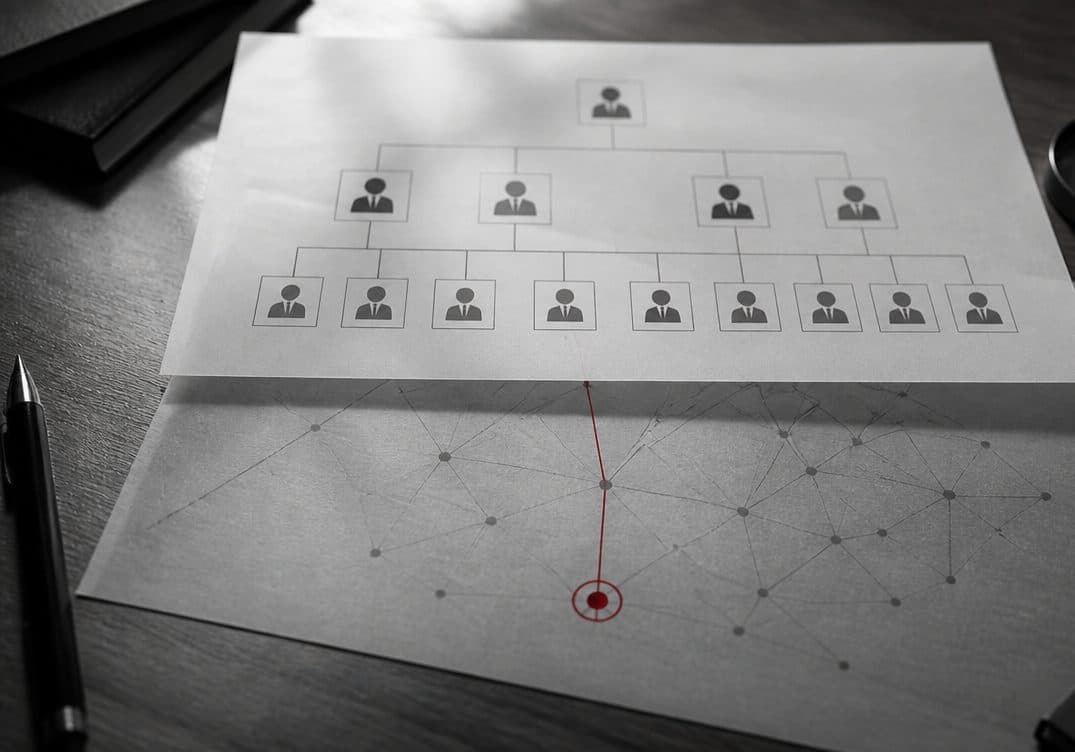
The upper layer is what is recorded in the register. The lower layer is who actually makes decisions. Marked in red is the node where the formal structure diverges from actual control.
Красная линия - там, где формальное владение расходится с реальным контролем
What formal and actual ownership mean
Formal ownership is what is recorded on the register: a specific person holds the interest, is listed as a member or shareholder, is named in the constitutional documents. Actual control is the ability to determine the company's decisions in practice: to appoint the manager, dispose of funds, approve transactions, influence strategy. In a transparent company these two layers coincide: the one who owns is the one who decides.
A nominee arrangement breaks that link. The formal owner remains on the register, but the decisions are made by another person - the beneficial owner. The international transparency standard set out in the FATF recommendations proceeds from the premise that behind every legal entity there is a natural person who ultimately owns or controls it, and requires that such person be identified.
The practical significance for the client is simple: you sign the contract with the person who is recorded, but you are in fact dealing with the person who decides. If these are different people, everything changes - who actually bears the obligations, whom to approach in a dispute, whose risks you are taking on. The formal entry answers the question of who the owner is on paper, whereas you need an answer to the question of who will make the decision when something goes wrong.
Important from the outset: the presence of a nominee owner does not amount to a breach. A gap between the formal and the actual layer is an indicator that calls for understanding, not proof of bad faith. What that gap means in a particular case is determined by the context, not by the mere fact of its existence.
Two layers checked separately
- formal ownership per the entry on the register
- actual control over the company's decisions
- whether these layers coincide or diverge
- who in fact bears the obligations under the contract
Граница вывода. A gap between formal ownership and actual control is an observation. It proves neither illegality nor intent and calls for an explanation, not a label.
When a nominee arrangement may be lawful
Nominee ownership does not exist solely for concealment. It has lawful grounds, and a proper check must take them into account rather than treat every nominee as a sign of deception. Otherwise the conclusion will be biased rather than analytical.
The lawful reasons vary. Trusts and fiduciary structures, where the formal holder manages the asset in the beneficiary's interests under a transparent agreement. Asset management, where a professional manager is recorded as the holder under a contract. The confidentiality of a private individual who for lawful reasons does not want publicity but discloses the beneficial owner to the regulator and the bank. Corporate and tax structures set up within the law.
The key difference between a lawful arrangement and a problematic one lies not in the fact of nominee ownership itself, but in transparency towards those who are entitled to know. A lawful structure discloses the beneficial owner to the bank, the regulator and the counterparty upon a justified request; a problematic one conceals him precisely from those who have the right and the grounds to know. The indicator of risk is not that the beneficial owner is not public, but that he is concealed where disclosure is required.
For the client this means framing the question correctly. Not "is there a nominee" - a nominee may be lawful - but "is the real beneficial owner disclosed where this is required, and does what is disclosed match what is observed". The check answers the second question.
Lawful grounds for nominee ownership
- trusts and fiduciary arrangements with disclosure of the beneficial owner
- professional asset management under contract
- confidentiality alongside disclosure to the regulator and the bank
- lawful corporate and tax structures
Mismatch between the owner's profile and the scale of the business
One of the first observable indicators is a mismatch between who formally owns the company and what that company actually is. A large business with turnover, assets and an international structure, registered to a person with no trace of the corresponding experience, resources or history, is not proof of nominee ownership, but it is a reason to ask.
Observable mismatches vary. An owner of a significant asset with no business history and no other projects of comparable scale traceable in open sources. A formal owner whose age or biography sits poorly with the duration and complexity of the business. A sole shareholder of several unrelated companies in different industries and countries with no visible logic. A holder of a stake who at the same time appears as an ordinary employee or a person with no business activity.
Each such observation is lawfully derived from open data: corporate registers, publications, professional references. But individually its weight is low. A mismatch may have simple explanations: inheritance, a family business, an entrepreneur at the start of his career, privacy. The indicator becomes significant only in combination with others and after the obvious lawful explanations have been checked and not confirmed.
The practical value lies in prioritisation. A profile mismatch does not deliver a verdict, but it shows where to look next: whose capital stands behind the company, where the funds came from, who actually manages it. This is not the end of the check but its proper beginning.
What is observed in the owner's profile
- the scale of the business against the owner's business history
- age and biography against the complexity of the structure
- participation in unrelated companies with no visible logic
- the status of the stake holder against his business activity
Recurring addresses, directors and corporate service providers
The second observable layer is repetition. The same addresses, directors, secretaries and corporate service providers appearing in companies that at first sight are unrelated may point to a common centre of control behind formally separate structures.
Repetitions are of several kinds. A shared registered address for numerous companies - often this is the address of a corporate service provider, which is lawful and common, but sometimes indicates connection. One director or nominee secretary in dozens of structures. The overlap of the same individuals between companies that on the documents are unrelated. A sequence of corporate changes taking place simultaneously across a group of formally independent legal entities.
This is where it is particularly easy to be wrong. A mass registration address is not in itself an indicator of a violation - thousands of lawful companies are registered through providers. A professional director may lawfully hold positions in many structures. Weight is acquired not by the repetition itself, but by its combination with other signals and the absence of a simple explanation. The check separates technical connection through a provider from connection through real common control.
The practical value lies in reconstructing the map. Recurring elements make it possible to see a possible single structure behind a set of formally separate companies and to form a hypothesis as to where the lines of control converge. But it remains a hypothesis: a connection reconstructed from repetitions is a reasoned conclusion, not a confirmed fact, and is stated accordingly.
Which repetitions are tracked
- a shared registered address across unrelated companies
- one director or secretary in many structures
- the overlap of individuals between companies
- simultaneous corporate changes across a group
Control through financing, powers of attorney and contracts
The most telling layer is not ownership but control. A person may hold no shares at all and still determine every decision of a company. Control is exercised through instruments that often remain outside the formal ownership structure.
The observable mechanisms of control vary. Financing: if a company operates on funds from a single person or a related structure, real influence often lies with whoever provides the money rather than with whoever appears in the register. Powers of attorney with broad authority, allowing a person to act on behalf of the formal owner. Shareholders' agreements, options and share pledges, which redistribute actual power without changing the entry in the register. Management contracts under which decisions are in fact taken by the manager rather than the owner.
These instruments are lawful in themselves - ordinary corporate life is built on them. What makes them an indicator of possible nominee ownership is not their existence but a discrepancy: where actual power is systematically held by someone other than the recorded owner, and that discrepancy is concealed. Some of these instruments appear in documents and disclosures; others remain in private agreements and can be reconstructed only from indirect indications.
The practical significance lies in a shift of focus. A check on control answers the main question differently from a check on ownership: not "who is recorded" but "who actually decides and through which levers". The answer to the second question determines who you are in fact dealing with.
How control is exercised
- financing of the company by a single person or structure
- powers of attorney with broad authority
- shareholders' agreements, options and share pledges
- management contracts in place of owner decisions
Граница вывода. Instruments of control are lawful in themselves. The indicator is a systematic discrepancy between the formal owner and the person who actually decides, not the presence of the instrument.
Change of owner before a transaction or dispute
A separate indicator of comparable weight is timing. Changes in an ownership structure are lawful in themselves and occur constantly. But their timing relative to significant events - a transaction, a dispute, enforcement, an inspection - changes their weight.
The scenarios that warrant attention concern not the fact of a change but its timing. Transfer of a share or an asset shortly before a transaction in which it matters who really stands behind the company. A change of owner on the eve of court proceedings or the filing of claims. Restructuring before enforcement, after which key assets end up held by a different person. A rapid sequence of re-registrations that severs the link between the current owner and the company's past.
Each such change is lawful, and each may have an innocuous explanation: a planned reorganisation, a partner's exit, tax planning, inheritance. The problem is created not by the change but by its coincidence in time with an event to which the change is advantageous, together with the absence of any other explanation. A change of name or structure also severs the search history: events tied to the previous state can no longer be found under the new one - and that in itself is worth reconstructing.
The practical significance lies in checking the chronology. Reconstructing the sequence of changes and comparing it with external events shows whether the restructuring was ordinary corporate life or preparation for a specific situation. Here again the answer is framed as a conclusion, not as an accusation.
What is compared against the timeline
- transfer of a share before a significant transaction
- change of owner on the eve of a dispute or claims
- restructuring before enforcement
- a series of re-registrations that severs the history
How a real beneficial owner is confirmed through several sources
Establishing a beneficial owner is not a search for a single decisive document but the assembly of a picture from several independent sources. A single source may be wrong or out of date; agreement between several sharply increases the reliability of the conclusion.
The basis is official data. Corporate and trade registers, accessible through national systems and interconnected at European level, provide the formal ownership structure. Registers of beneficial owners, where maintained, add the declared beneficial owner - but the availability of such data differs greatly between jurisdictions, and the absence of an entry does not mean the absence of a beneficial owner.
Other layers sit on top of official data: publications with verifiable authorship, court and regulatory materials, sanctions lists, historical corporate information, traces of financing and management. Each source is checked for date and reliability, and the information is compared across sources. A discrepancy between the declared beneficial owner and observed control is not an error but a result, and it is recorded separately.
The practical significance lies in the durability of the conclusion. A beneficial owner confirmed by the agreement of several independent sources is a reliable basis for a decision. A beneficial owner reconstructed from a single indirect indicator is a hypothesis requiring further verification. The difference between the two is precisely the subject of the work.
Sources brought together
- corporate registers and the systems that consolidate them
- registers of beneficial owners, where available
- publications, court and sanctions materials as at the date
- traces of financing, management and corporate history
How to state a conclusion and a hypothesis correctly
The most frequent and most costly error in this area is to call a person a nominee on the basis of indirect indicators. This is not only legally risky, it also makes the result useless: an allegation without a reliable basis cannot be used in negotiations, in court or in a decision.
Proper work rests on separating three levels. A fact is what is confirmed by a register entry or an official document: a shareholding, a position, a date, an event. A conclusion is what follows from a combination of several facts: "the structure shows indications of control by a particular person". A hypothesis is an assumption requiring verification: "the formal owner may be acting in the interests of another person". These three levels are marked separately in the report and are never mixed.
The correct language follows from this. Not "a particular person is a nominee owner", but "a discrepancy is observed between formal ownership and indications of actual control", "the structure shows features characteristic of a nominee arrangement", "the actual beneficial owner is, with high probability, a particular person, which is confirmed by the agreement of the following sources". The wording reflects the weight of the evidence, not the desired conclusion.
The practical significance lies in usability. A conclusion correctly divided into fact, assessment and hypothesis can be used: a confirmed fact as the basis of a claim, a supported conclusion as a negotiating position and a basis for protective terms, a hypothesis as a direction for further verification. To mix them is to take a decision on the basis of an assumption treated as proven.
Three levels that are kept separate
- fact - confirmed by a register or a document
- conclusion - follows from a combination of facts
- hypothesis - requires further verification
- the language of the report reflects the weight of the evidence
Граница вывода. Calling a person a nominee on the basis of indirect indicators is a legal risk and a useless result. A correct conclusion separates fact, assessment and hypothesis and is worded according to the weight of the data.

What a professional process looks like
The order is not accidental: the formal structure is reconstructed first, the layer of control on top of it, and the depth is determined by the significance of the decision.
- 01
Defining the task
What the company is, what decision is to be taken, which jurisdictions are involved, what the deadline is, what is already known and from which source.
- 02
Formal structure
Owners, shareholdings, directors and history according to official registers. Precise identification of individuals, elimination of name matches.
- 03
Profile and repetitions
Whether the owners correspond to the scale of the business, recurring addresses, directors and related companies.
- 04
Control layer
Financing, powers of attorney, agreements and management contracts. Separating formal ownership from actual control.
- 05
Chronology
The sequence of changes and its comparison with external events - transactions, disputes, enforcement.
- 06
Bringing sources together
Confirmation of the beneficial owner by the agreement of several independent sources as at the date.
- 07
Report and decision
Fact, conclusion, hypothesis and the unknown - kept separate. Specific recommendations, not a nominee label.
What the client receives as a result
- The reconstructed formal ownership structure with precise identification of individuals and elimination of name matches.
- A map of connections with a clear separation: what is confirmed by a register, what has been reconstructed from a combination of indicators, and what remained unavailable.
- An assessment of the layer of control - through financing, powers of attorney and contracts - showing who actually takes decisions.
- A chronology of changes in the structure, compared with external events.
- A conclusion as to the actual beneficial owner, with its weight stated: confirmed fact, supported conclusion or hypothesis.
- A direct answer as to what the check did not establish and why - without allegations presented as evidence.
Limitations and the lawfulness of methods
Identification of a beneficial owner is based on open and officially available sources: corporate and beneficial ownership registers, court databases, sanctions lists, publications with verifiable authorship. The work does not use unlawful access to closed data, banking secrecy or personal information, and does not explain ways of circumventing disclosure.
The availability of data on beneficial owners differs sharply between jurisdictions: in some it is public, in some available on a substantiated request, in some closed. The absence of an entry in a particular register means that the data has not been disclosed in that source, not that there is no beneficial owner. A diligent check notes such limits rather than presenting what is unavailable as verified.
A check does not make legal determinations. Finding ownership to be nominal, establishing sham arrangements or bad faith is the prerogative of a court and of competent legal counsel. The materials of a check may serve as a basis for their assessment, but do not replace it. All figures and time frames are published only where supported by documents.

Composite example
A practical example
Исходная ситуация: что выглядело простым
A company was considering a major transaction with a counterparty formally owned by a single private individual. The registry structure looked simple: a sole owner, an operating company, activity in a specific field.
Первое несоответствие: профиль владельца
The first inconsistency appeared at the profile layer. The scale of the counterparty's activity implied substantial capital and history, yet open sources showed neither other projects of that level nor a corresponding business history behind the formal owner.
Второе несоответствие: повторы
The second appeared at the layer of repetitions. The registered address and one of the directors coincided with several other companies, formally unconnected with the counterparty but forming a recognisable group.
Третье несоответствие: контроль
The third appeared at the layer of control. Funding of the activity traced back to a structure that did not coincide with the formal owner, and the available materials showed indications of a management agreement.
Как это было сформулировано в отчете
None of these observations was called proof of nominal ownership. In the report they were set out as discrepancies and indications characteristic of a nominal arrangement, with a separation of what was confirmed, what was reconstructed and what was unavailable, and with a direct statement that final identification of the beneficial owner requires sources to which there is no lawful access.
Как изменились условия сделки
The decision was the client's. He did not abandon the transaction but changed its terms: he required disclosure of the beneficial owner as a condition of the contract, added guarantees from the related structure and divided the payment into stages. The uncertainty did not disappear - it became visible and was accounted for in the contract.
Граница вывода. A composite example based on typical matters; details have been changed. Пример показывает логику работы, а не результат конкретного клиента.
What to prepare for the initial assessment
- The exact name, registration number and jurisdiction of the company - from documents, not from a presentation.
- What decision is ahead: a transaction, an investment, a dispute, a partnership.
- Who is stated to be the owner and what is known about him.
- The jurisdictions connected with the company and its structure.
- What you have already checked yourself and from which sources.
- The date by which the decision is needed.
Documents and third parties' personal data are not required at the first stage. The items listed above are enough to assess the volume of work and the time frame.
Frequently asked questions
Open data establishes indications and discrepancies between formal ownership and actual control, and the beneficial owner is confirmed where several sources coincide. But the final finding that ownership is nominal is often a matter of data to which there is no lawful access, and of legal determination made by a court. A check states that limit honestly.
On its own, almost never. Thousands of lawful companies are registered through a single corporate provider at a common address. It becomes an indication in combination with other signals - shared directors, funding, simultaneous changes - and after the technical explanation through the provider has been checked and not confirmed.
No. Nominal and fiduciary arrangements can be entirely lawful: trusts, asset management, lawful confidentiality with disclosure to the regulator and the bank. The risk is created not by the nominal arrangement itself, but by concealing the beneficial owner from those with a lawful right to know it.
It is a profile inconsistency that indicates where to look next, but proves nothing. It often has simple explanations: inheritance, a family business, a successful young entrepreneur, privacy. An indication acquires weight only together with others and after the obvious lawful explanations have been checked.
For a decision - who controls. A person may hold no shareholding at all and still determine everything through funding, powers of attorney and contracts. A check of ownership answers the question "who is on record"; a check of control answers "who actually decides". It is the second answer that shows who you are in fact dealing with.
It depends on the depth and the jurisdictions. The time frame is stated once the task has been defined and begins with agreement on the scope. A formal structure based on open registries is reconstructed faster than a layer of control across several countries. We give a precise estimate only for a specific task.
No. For an initial assessment, the name of the company, the jurisdictions and the substance of the decision are sufficient. Sensitive materials and third parties' personal data are not requested at this stage - a secure method of transfer is agreed separately if the work continues.
Structured material in which fact, conclusion and hypothesis are kept separate: the formal structure, a map of connections, an assessment of control, a chronology of changes and a conclusion on the actual beneficial owner with an indication of the weight of the evidence. Not a "nominee" label, but a basis for a decision and, if required, for the work of your lawyer.
Conclusion
Nominee ownership is not a single indicator that can be pointed to, but a discrepancy between two layers: what is recorded in the register, and who actually makes decisions. Neither a matching address, nor a young owner, nor a complex structure proves anything in itself.
The value of an honest check lies in the discipline of the conclusion. It shows where the formal structure diverges from actual control, confirms the beneficial owner by agreement between several sources, and separates fact, assessment and hypothesis so that the result can be used. The task is not to label a person a nominee, but to give you a clear picture of control and to state honestly what remains unproven. With such a picture, the decision is made by you, not by guesswork.
Официальные источники
- FATFBeneficial ownershipпроверено 05.08.2026
The international standard for establishing the ultimate beneficial owner of a legal entity - the basis of requirements for transparency of control.
- European e-Justice PortalBusiness registers - search for a company in the EUпроверено 05.08.2026
Official access to national commercial registers of the EU - a source of the formal ownership structure and corporate connections.
- European e-Justice PortalBeneficial Ownership Registers Interconnection System (BORIS)проверено 05.08.2026
The system interconnecting national beneficial ownership registers of the EU - confirms that access to such data differs by jurisdiction.
- European CommissionOverview of sanctions and related resourcesпроверено 05.08.2026
Official information on the restrictive measures of the EU in force - a source for checking the beneficial owner and connected persons as at a given date.
Связанные материалы
 Case
CaseA hidden beneficial owner in an offshore structure
Reconstruction of actual control from the totality of open data, separating what is confirmed from what is assumed.
- 01 /ServiceIdentifying the beneficial owner
- 02 /ArticleHow to check a counterparty before a deal
- 03 /ArticleWhat a check on an individual shows before entering a partnership
- 04 /ArticleHow debtors move assets out and what this changes for the creditor
- 05 /ServiceCompany checks and Due Diligence
- 06 /ServiceChecks before a transaction or contract
Establish the actual beneficial owner of a company?
Describe the company, the jurisdictions and the substance of the decision in two or three sentences. We will tell you what can realistically be checked in your case, within what time frame and what will remain unavailable. Documents are not needed at the first stage.